Serve & Return

Padel Serve Mastery: Unpacking Pro Biomechanics & Tactics

Discover the crucial technical and tactical insights from professional padel that will transform your serve.

Reading as PlayerOne story · two ways to read it
▲ Player edition — what to try on court

Your serve is your secret weapon for getting to the net, and mastering it tactically is key to winning more points. This isn't just about putting the ball in play; it’s your first offensive strike, setting the stage for everything that follows. Professional insights highlight that while the serve makes up about 10% of all shots in a match, its success isn't about brute force. Instead, it hinges on smart tactical choices: where you aim, how fast you hit it, how deep it lands, and even which side of the court you serve from. By understanding these elements, you'll learn to manipulate your opponent's return, giving you and your partner the crucial advantage of arriving at the net first. Think of your serve as the opening move in a chess game – you’re not just moving a piece, you’re planning several steps ahead to gain positional dominance.

The core idea is to think of your serve less as a simple formality and more as a precision tool. A deep, well-directed serve can force a weak return, allowing you to easily advance to the net. A wide serve can pull your opponent out of position, creating space for your partner to cover or setting up an easier second shot for you. The pros aren't just hitting the ball; they're strategically placing it to initiate an attack. They understand that gaining the net is paramount—teams that control the net win significantly more points. This means every serve you hit needs a purpose, a clear intention to disrupt your opponent's rhythm and create an opportunity for you to move forward. It’s about creating an immediate advantage and then capitalizing on it.

This approach isn't just theoretical; a biomechanical analysis of the serve confirms that the best serves are executed through a series of precise phases and stages, emphasizing efficient movement and contact. This isn't necessarily about generating maximum power, but rather about consistent, repeatable mechanics that allow for accurate and varied placement. By consciously varying your serve's direction, speed, and depth, you force your opponents to react differently each time, preventing them from settling into a comfortable return rhythm. This tactical variability, combined with sound biomechanics, gives you a strong foundation to build points from a position of strength right from the start.
By the numbers
10serve percentage of strokes

On court: try this

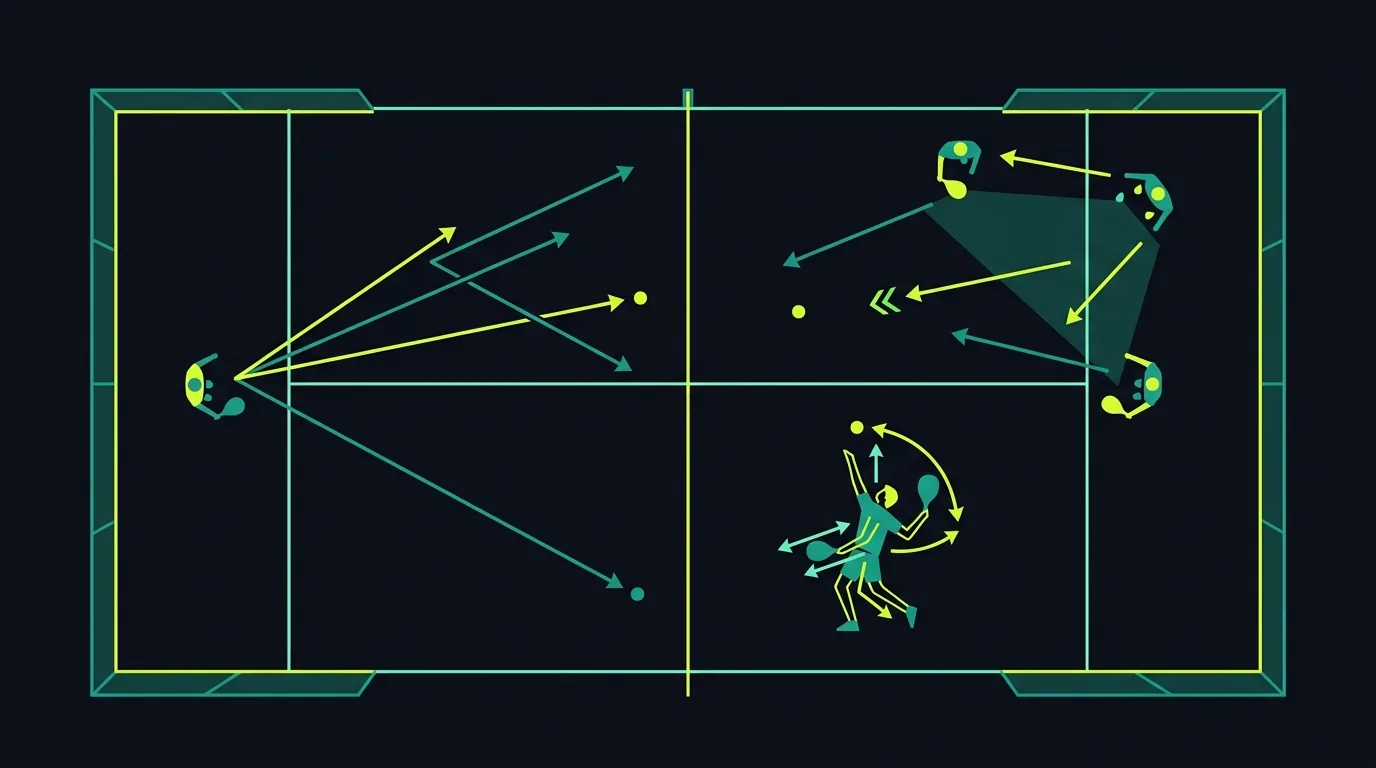
  1. Serve wide on the deuce side to the glass: When serving from the deuce (right) side, aim your serve wide towards the side wall on your opponent's deuce side. Your goal is to make the ball bounce and hit the glass (cristal) in the corner, forcing your opponent to play a challenging return close to the side wall. This pulls them wide, opening up the court. As soon as you hit, take a quick split step and move aggressively towards the net to establish your offensive position.
  1. Vary depth on the advantage side, then attack the middle: From the advantage (left) side, try alternating between a deep serve that aims for the glass in the back corner and a shorter serve that bounces closer to the service line. A deep serve pushes your opponent back, limiting their attacking angles. A shorter serve, if executed with controlled speed, can catch them off guard and force a difficult low return. After both serves, prioritize your movement to the net, looking to cover the middle, as a weak return often comes back there.
  1. Target your opponent's body or the "T": Sometimes, the best tactical serve is one aimed directly at your opponent's body or down the middle on the "T" (the intersection of the service line and the center service line). This takes away their angle and can force an uncomfortable, defensive return, particularly if they are slow to adjust their footing. Use this when you want to minimize their attacking options and quickly move in to control the net. Remember to always get low and hit below the waist after the bounce, as per padel rules.

Drills to practise

  1. Target Practice: Directional Control:
* Set up: Place cones or use existing court lines to create two small target zones within the service box: one wide near the side wall, and one closer to the "T" (the center service line). * Focus: Practice serving 10 balls to each target zone from both the deuce and advantage sides. Concentrate on controlling the direction of your serve. Pay attention to your toss and racket face angle at contact. * Improvement: You'll know you're improving when you consistently hit your target zones, forcing your partner (or an imaginary opponent) to move out of position. Aim for 7 out of 10 serves in the target zone.
  1. Depth and Second Bounce Drill:
* Set up: With a partner standing on the baseline, practice serving. Your partner's job is to observe where your serve's second bounce lands. Focus: Hit 15 serves from each side of the court, aiming to vary the depth. For 5 serves, try to make the second bounce land before the service line. For another 5, aim for it to land between the service line and the back glass. For the final 5, aim for the second bounce to be after* the back glass (a deep serve that hits the glass). Focus on the height of your toss and the amount of topspin or slice you apply. * Improvement: Your partner should be able to clearly identify the different depth zones. You're improving when you can consistently hit each depth target on command, making it harder for your opponent to predict the bounce.
  1. Serve and Volley Entry Drill:
* Set up: You and your partner start at the baseline. You serve, and your partner practices returning the serve. * Focus: After every serve, your primary focus is to move quickly and efficiently to the net position. Emphasize a quick split step after contact and aggressive forward movement. Your partner should try to hit returns that challenge your net approach. Don't worry about winning the point; focus solely on the quality of your serve and your subsequent movement to the net. * Improvement: The goal is to consistently reach the net and be ready for your first volley before your partner's return crosses the service line. You'll feel more composed and less rushed as you improve.

Common mistakes

* Lack of variation: Many players hit the same serve every time.
* > Quick fix: Before each serve, consciously decide if you're going for direction (wide, body, T), depth (short, medium, deep to the glass), or a slight variation in speed. Don't be predictable.
* Not getting to the net fast enough: A good serve is wasted if you're not in position to capitalize.
* > Quick fix: Immediately after striking the ball, take a quick, explosive split step and move forward. Your first priority is to reach the net, not watch your serve.
* Over-focusing on power: Trying to blast the ball often leads to unforced errors or easily returnable serves.
* > Quick fix: Prioritize placement and depth over raw power. A well-placed serve at moderate speed is far more effective than a fast serve down the middle. Remember, you can't hit it like a tennis serve over the waist.
* Inconsistent low contact point: Hitting the ball too high on your serve.
* > Quick fix: Practice your toss to ensure the ball bounces to a consistent height that allows you to make contact well below your waist. Use your legs to get low for the serve, not just your arm.

Take it to your next match

Next time you step on court, make it your mission to approach your serve with purpose. Consciously think about your direction, speed, and depth before every single serve. Challenge yourself to use all four tactical parameters to keep your opponents guessing. And crucially, commit to that aggressive move to the net immediately after you strike the ball. Take the initiative, get to the net, and control the point from the very first shot. You've got this!

◆ Coach edition — how to teach it

The idea

The serve in padel, while making up roughly 10% of all strokes in a match, is far more strategically important than its frequency might suggest. This research, a narrative review of professional padel, highlights how effective serving is your first and best chance to gain control of the point. Unlike tennis, the underhand serve in padel means raw power isn't the primary weapon. Instead, it’s about precision, disguise, and setting up the next shot.

For us coaches, this means shifting our focus. We need to help our players understand that a well-executed serve isn't just about getting the ball in play; it's about immediately putting pressure on the opponent and, crucially, allowing the serving pair to advance to the net. Gaining the net is paramount in padel, as points won from this offensive position are significantly higher. When we dissect the serve, we're looking at key tactical parameters: the direction of the serve, its speed, its depth, and even the court side from which it’s executed. Each of these elements can be manipulated to disrupt the returner's balance, force a weak return, or create an opening for the server and their partner to take the offensive.

Understanding the serve from a biomechanical perspective also gives us a clearer picture of efficient movement. It breaks down the action into distinct phases and stages, from the initial setup to the follow-through. This isn't just academic; it helps us isolate and refine specific movements for greater consistency and tactical effectiveness. For instance, a small adjustment in racket preparation or contact point can dramatically alter the ball's trajectory, leading to a deeper serve that hits the back glass or a wider serve that forces the opponent out of position. Ultimately, the serve is the initial spark that ignites the point, and mastering its technical and tactical nuances is fundamental for setting up winning rallies. While the study is a review of existing literature, it helps frame our coaching around established principles of professional play.

How strong is the evidence?

This guide is based on a narrative review of existing literature on the technical and tactical aspects of the padel serve in professional play. As a review, it synthesizes and discusses findings from multiple studies rather than presenting new empirical data or conducting statistical analyses itself. Therefore, it primarily defines and describes the key tactical parameters (direction, speed, depth, court side) and outlines the biomechanical phases of the serve.

What it does not establish is causality – it doesn't definitively prove why certain tactical choices or biomechanical adjustments lead to specific outcomes. Nor does it provide new quantitative data, beyond what was aggregated from previous research, such as the serve's frequency in matches or the advantage of net play. The findings are contextualized within professional padel, so coaches should consider how these principles might be adapted for players at different levels, as the dynamics of elite play may not always directly translate to recreational or developing players without careful consideration. It offers a valuable framework for understanding, but specific prescriptive numbers beyond those cited here were not part of this review's scope.

Coaching cues & teaching points

* "Aim for the glass!": Emphasise serving wide towards the side wall (glass) to open up the court and force a stretched return. This is about maximizing direction.
* "Deep to the fence!": Encourage players to aim their serve to land deep in the service box, ideally bouncing near the back fence, to limit the returner's angles and depth. This targets depth.
* "Control the speed, place the ball": Remind players that underhand serves prioritise placement over raw power. The goal is a controlled speed that allows the ball to bounce effectively and give time to get to the net. This focuses on speed.
* "Open the body, then close": For biomechanics, focus on a smooth racket preparation with a slight open stance, followed by rotating the torso through the ball for efficient power transfer.
"Hit down, then through": Cue the contact point to be slightly above the ball after its bounce, guiding the racket face down on the ball to control height, then through* the ball towards the target.
* "Serve from the corner, move to the middle": On the deuce side, serving from near the T-line allows for an angled serve to the glass. On the advantage side, serving from slightly wider can create an even sharper angle. Immediately after contact, "move to the net, ready to volley!"
> "The serve is the start of your* attack. Don't just serve it; place it with intent."

Drill & session plan

  1. Target Serve Placement (Isolated Rehearsal)
* Setup: Place cones in the service box: one near the side glass (wide serve), one deep towards the back fence (deep serve), and one near the T-line. Players serve 10 balls to each target. * Coaching Focus: Emphasize consistent contact and racket path to achieve desired direction and depth. Players should experiment with slight variations in toss position and racket face angle. * Success Criterion: 7 out of 10 serves land within the target area for each cone before moving on.
  1. Serve & Advance Cooperative (Cooperative Play)
* Setup: Server serves, moves to the net. Receiver stands at the baseline and returns a controllable ball (e.g., a simple lob or a slow groundstroke) to the server's volley zone. Server volleys, point ends. Coaching Focus: The primary focus is the server's immediate movement to the net after* their serve. Emphasize a quick transition, racket ready, and split-step. Encourage tactical serves that make the net approach easier. * Success Criterion: Server reaches the net in an athletic position before the receiver's return, and makes a controlled volley 80% of the time.
  1. Pressured Serve Zones (Pressured Play)
* Setup: Mark two high-value zones in the service box for the returner: Zone 1 (wide to the glass), Zone 2 (deep to the back fence). Players play 5 points where serving to Zone 1 or 2 results in an extra point for the server, regardless of the rally outcome. * Coaching Focus: Players must consciously choose a serve direction and depth based on the "bonus" zones, under light pressure. Encourage trying to surprise the opponent with varied serves rather than always hitting the same target. * Success Criterion: Players successfully hit a bonus zone with their serve on at least 3 out of 5 attempts, demonstrating tactical intent under pressure.
  1. Serve to Win the Net (Game Play)
Setup: Play full points, but with a specific objective: the serving team must win the net position and* the point. If the returning team reaches the net first, the serving team loses the point, regardless of who wins the rally. * Coaching Focus: Integrate all elements: tactical serve choice, efficient net approach, and strong first volley. Encourage communication between serving partners about where to place the serve and how to cover the court. * Success Criterion: The serving team wins at least 60% of the points by successfully taking and holding the net, demonstrating effective serve strategy and follow-up.

Common student errors & corrections

* Error: Consistent serves into the net or too short.
* Cause: Improper ball toss (too low or too close to the body), causing contact point to be too far forward or downward. Also, lack of leg drive.
Fix: "Toss the ball higher, further in front, and let it drop naturally." Use a constraint: Serve over a low elastic band* placed across the net to ensure sufficient height and forward trajectory. "Push through your legs as you hit."
* Error: Predictable serve direction; always serving to the same spot.
* Cause: Lack of intentional target practice or body disguise. Players often default to the easiest serve.
* Fix: "Choose your target before you toss. Disguise with your body: make every serve look like it's going wide." Drill: Alternating Targets – server must alternate between wide and deep serves with each attempt.
* Error: Server remains at the baseline after serving, failing to get to the net.
* Cause: Lack of urgency, poor habit, or fear of leaving the baseline.
Fix: "Serve and run to the net!" Constraint: Serve-and-Touch Cone* – place a cone just inside the net near the T-line. The server must serve, then touch the cone before the receiver's return bounces a second time.
* Error: Serve bounces twice in the service box before hitting the glass, or hits the glass too high.
* Cause: Insufficient depth or excessive top/backspin, or incorrect contact point for desired trajectory.
Fix: "Aim for the back corner of the service box. Feel like you're pushing the ball through* the court, not just over the net." Emphasize hitting with a flat to slight topspin motion that drives the ball forward into the court.

Adapting for levels

* Beginner Players:
* Focus: Core fundamentals of legality, consistency, and getting the ball over the net and in the service box. Introduce the basic concept of aiming for the glass, but without heavy tactical emphasis.
* Cues: "Bounce, hit under the waist, over the net." "Aim for the wide wall."
* Drills: Target Serve Placement with larger target zones. Serve & Advance Cooperative simplified to just serving and getting to a ready position at the net, less focus on the volley.
* Intermediate Players:
* Focus: Developing intentionality with serve direction and depth. Introduce the idea of opening up the court. Start linking the serve to the net approach more explicitly.
* Cues: "Wide to the glass, deep to the fence. Which will put more pressure on them?" "Serve, then split-step at the net."
* Drills: Target Serve Placement with tighter zones. Pressured Serve Zones to introduce tactical decision-making. Serve & Advance Cooperative with more focus on the quality of the first volley.
* Advanced Players:
* Focus: Nuance, disguise, and advanced tactical decision-making based on opponent's strengths/weaknesses and court position. Refine biomechanical efficiency for subtle variations in spin and pace.
Cues: "Can you serve to their backhand glass and anticipate their return cross-court?" "Vary your speed, keep them guessing." "What serve forces your* strong volley?"
* Drills: All drills from Serve to Win the Net onwards, with specific tactical constraints, e.g., "Serve to their weaker side, then play out the point." Implement Game Start Mastery with high-level tactical objectives against skilled opponents.

By the numbers
10serve percentage of strokes
Padel Profe© 2026 · Spiegamelo