
Serve & Return

Where You Stand at Serve Decides More Than You Think

New data from 1,071 high-level points reveals which serve positions tilt the odds in your favour.

Reading as PlayerOne story · two ways to read it
▲ Player edition — what to try on court

Your starting position before you serve — not just where you aim the ball — shapes how many points your pair wins. Research tracking over a thousand serve points in high-level national-category padel found a clear relationship between the tactical formation you and your partner adopt at the moment of serve and point outcomes, with the traditional formation coming out ahead of the Australian.

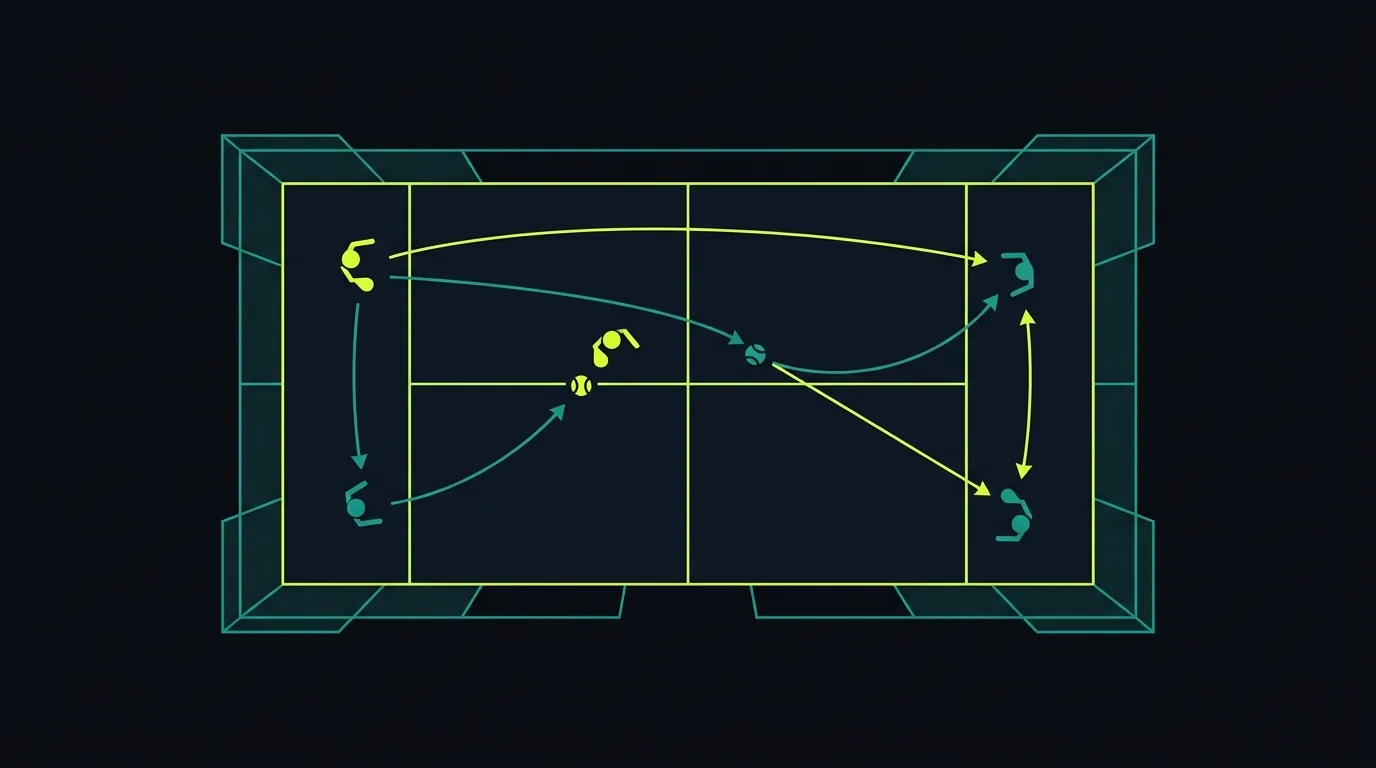
It's worth being precise about what those two formations mean. In the traditional formation, you serve and your partner stands at the net on the same side of the court as you — both of you on the right, or both on the left. In the Australian formation, your partner crosses to the opposite side of the net before you serve, so the pair is positioned diagonally. Teams use the Australian to disrupt return patterns, cut off cross-court angles, or take away an opponent's favourite landing zone.

The research also revealed a strong directional habit depending on which side of the court you're serving from. On the left side (the "advantage" side, where the odd-scoring service box sits), players at high level overwhelmingly direct their serve toward the side wall — the glass panel beside the returner — between 75% and 85% of the time. The geometry rewards this: a side-wall serve generates a bounce that pushes the returner wide and compresses their return window, especially on the backhand.

On the right side of the court, the picture changes. Serves toward the T — the central dividing line between the two service boxes — become meaningfully more common, and this shift is especially pronounced when pairs deploy the Australian formation. The T serve on the right targets the returner's body or forces a crowded backhand, and the Australian setup removes the obvious cross-court escape route.

Here is the strategically interesting part: overall, traditional-formation pairs won a higher percentage of serve points than Australian-formation pairs. That gap became a reported-but-unquantified trend rather than a decisive advantage when the analysis focused on specific serve directions — T or side wall, from either side — meaning the formation effect is not simply a matter of which direction you choose. There is something about the spatial dynamic and recovery positioning of the traditional setup that the Australian does not replicate as consistently.

One more piece of tactical intelligence worth carrying into your next match: the traditional formation's advantage erodes as a match goes longer. Points won on serve declined across sets, and this drop was especially noticeable with the Australian tactic from the second to the third set. Whether that reflects fatigue, the opposing pair adapting, or both is not established by this study — but the pattern suggests the Australian is best used selectively rather than as your default across a full match.

By the numbers
75%-85%serves to side wall (left court)
1071total points analyzed
9number of matches
36number of players

On court: try this

1. Traditional on the left side, target the glass

You're serving from the left, partner at net on the left side. Aim for the side wall — direct the ball so it clips the glass and kicks away from the returner. Your partner's position guards the cross-court angle; the side-wall serve pushes the returner even wider. If they somehow redirect cross-court, your partner is already covering it. This is the dominant pattern at high level because the geometry simply works: serve, glass, corner pressure.

2. Australian on the right side, serve through the T

You're serving from the right with your partner already crossed over to the left net position. Now the T serve makes spatial sense — your partner has removed the obvious cross-court escape route, so pushing the ball toward the central dividing line targets a tighter space and can force a cramped backhand or a weak lob. This combination is most coherent when you commit to it before the point begins.

Coach tip: When you choose Australian, your partner must be fully settled into position before your service motion starts. A late switch telegraphs the formation and gives the returner extra time to read and adjust.

3. Traditional on the right side — keep both directions live

With traditional formation on the right, you have a genuine two-way threat: side wall or T. Read the returner. If they're crowding the central line expecting a body serve, the side-wall serve opens the line. If they're camped wide expecting glass, push it through the middle. Keeping both options credible is precisely what the traditional setup on this side gives you — the returner cannot pre-commit.


Drills to practise

  1. Side-wall targeting from the left — Serve from the left service box aiming to hit the side glass before the ball crosses the service line. Place two cones marking a roughly 60 cm target zone where you want the ball to land after the bounce. Aim for five consecutive serves that hit the zone. You're improving when the ball reliably draws the returner outside their comfortable hitting corridor, not merely touching the glass.
  1. Australian switch footwork — With a partner, practise the formation switch at serve with no ball first. Call "Australian", your partner moves to the opposite net side, you take your serving position, then both reset to normal. Ten repetitions until the movement is automatic. Add a serve and a live return once the footwork is clean. The benchmark: your partner is stationary before your racket begins its backswing.
  1. Right-side direction choice — Serve ten balls from the right service box, alternating T and side-wall, with a training partner returning. After each point your partner calls which delivery gave them the harder ball. Tally the results across two sessions. This builds real feedback on which direction earns you the better return from an actual opponent — not just which feels tidy to hit.
  1. Third-set fatigue simulation — Set a timer for 25 minutes and play out serve points only, switching formations every five minutes. Track how many points each formation wins per block. If your Australian win-rate drops sharply in the later blocks, that is your personal signal to lean traditional when a match stretches into a third set.

Common mistakes

    1. Using the Australian as a default, not a variation. The research shows a reported drop-off in Australian effectiveness as the match progresses. Deploying it reflexively, rather than purposefully, risks surrendering the advantage you'd have with traditional positioning. Fix: reserve the Australian for specific situations — a predictable returner, a particular score context — rather than running it as your standard formation.
    1. Ignoring which service box you're in. Serve tactics are not symmetrical: the left side strongly favours the side wall, the right side opens up the T. Treating both boxes identically means missing a real structural pattern. Fix: before you bounce the ball to serve, take two seconds to confirm your side and which formation you've agreed with your partner.
    1. Serving to the T from the left without formation cover. A T serve from the left opens a wide cross-court angle. Without your partner positioned to cover it, you're handing the returner a comfortable ball into open court. Fix: if you go T from the left, confirm your partner's net position accounts for that cross-court window before you commit.
    1. Partner drifting into the Australian switch mid-serve. A partner who is still moving as you contact the ball removes all the tactical disruption the formation is meant to create — the returner simply aims at the gap. Fix: the switch is complete before your service motion begins, full stop.

Take it to your next match

Start with traditional as your default for the whole match and pay attention to which side you're serving from: side wall on the left, and on the right stay open to either direction depending on what the returner is showing you. If you want to try the Australian, limit it to two or three moments per set where you have a specific read on the returner — something concrete to exploit, not just variety for its own sake. Keep it early in the match while it's freshest, track honestly whether it earns you something, and build from there.

◆ Coach edition — how to teach it

At elite level, how a pair lines up for serve shapes point outcomes as much as the serve itself. This study tracked 1,071 serve points across nine high-level matches and found consistent patterns in where players serve and how tactical positioning connects to winning the point.

The headline finding is how lopsided left-side serving is. On the left — the advantage side — players serve to the side wall between 75% and 85% of the time. That near-unanimity is not accidental. The side wall serve angles the ball away from the returner's most comfortable cross-court option, forces a weaker or more defensive return, and lets the serving pair take the net on favourable terms. At this level, it has become close to a default — and the data suggest it is a sound one.

The right side tells a different story. Here, players mix in more T serves, particularly when the pair is standing in the Australian formation. The Australian shifts the net player towards the centre rather than their typical wide position, which opens the T corridor as a logical target. This suggests elite pairs are using serve direction and court positioning as a coordinated tactical decision — not just the server's individual call.

The most practically important finding concerns which formation wins more points. Pairs using the traditional formation win a higher percentage of serve points overall than those using the Australian. That matters for how you coach the Australian as anything other than a change-up. But there is an honest qualifier you need to know: when the researchers broke the data down by serve direction and court side, the advantage of traditional over Australian was not statistically significant in those sub-groups. So the overall difference may partly reflect when and why pairs choose the Australian, not the formation itself. Treat the headline result as a trend worth discussing with your players, not a law.

The match-progression finding is the one coaches tend to overlook. The percentage of points won on serve declines as the match progresses — a pattern familiar from other racket sports — but the decline is steeper with the Australian tactic, particularly from the second to the third set. Whether that reflects physical load, tactical recognition by the returning pair, or something else, the study does not tell us. What it does tell you is that if your players are using the Australian as their primary structure rather than a targeted surprise, it may cost them late in a tight match.

The Australian formation works best as a deliberate disruption, not a default. If your players are leaning on it all match, this research gives you a practical reason to revisit that habit.

What ties these findings together is a straightforward coaching truth: at high-level padel, serve is a pair decision, not a solo act. The server's position, the net player's position, and the serve direction form a tactical triangle. This research makes that triangle visible, which is exactly the kind of data you can bring into a debrief.


By the numbers
75%-85%serves to side wall (left court)
1071total points analyzed
9number of matches
36number of players

Coaching cues & teaching points

    1. "Where's your partner before you toss?" — establish the habit of a split-second glance to confirm formation before the serve motion begins.
    2. "Side wall on the left, every time unless we've called different" — reinforce the default pattern; any variation should be a deliberate choice, not drift.
    3. "Australian means T" — when using the Australian on the right side, the serve should target the T as the coordinated direction. Make this pairing automatic through repetition.
    4. "Serve into the plan, not just into the box" — the server's job is to set up the net player's first volley, not simply land the ball in.
    5. "Third set, keep it simple" — if the Australian has been a primary structure late in a match, cue pairs to return to traditional.
    6. "Read the returner's feet before you toss" — positional cues from the returner inform direction variation; the decision-making process starts before ball contact.

Drill & session plan

  1. Formation call — feed, isolated
Setup: Coach feeds from the return box. Server and net player call "traditional" or "Australian" before each serve, then execute the formation with the correct serve direction — side wall on the left for traditional, T when Australian on the right. Focus: Embedding the call-then-execute habit and confirming both players know their position before the serve. Move on when: Both players relocate correctly on every call for 10 consecutive serves without prompting.
  1. Serve-and-one — cooperative
Setup: Two pairs. The returning pair cooperates — returns the ball but does not apply pressure. Focus is on the serving pair's net player taking the first volley from the position the formation creates. Focus: Quality of the net player's first volley. Is the serve direction actually setting up that first touch? Move on when: Net player wins or neutralises the exchange with a comfortable first volley on 7 of 10 points.
  1. Formation pressure — pressured
Setup: Normal points, but the returning pair knows the serving pair's formation in advance — coach calls it aloud before each point. Returners try to exploit the positioning. Focus: Server must vary direction intelligently within the formation's logic rather than becoming readable. Debrief after each point: did the serve direction serve the formation, or work against it? Move on when: Serving pair maintains a reasonable win rate under informed pressure across a block of 20 points.
  1. Match simulation with set tracking — game
Setup: Full points, scorekeeping, with someone logging the formation used on each serve. Play two sets. Focus: After the session, review which formation was used more in set two, and whether the win rate held. Prompt players to identify whether the Australian was used as a disruption or a default. Success criterion: Players can explain their own formation patterns and name one specific adjustment for the next session.

Common student errors & corrections

    1. Error: Net player doesn't adjust position when Australian is called. Cause: The server makes the formation decision in isolation; the net player reacts after the serve lands. Fix: The Formation call drill makes the verbal call non-negotiable. Both players must move before the toss — the formation is a pair act.
    1. Error: Serving to the T on the left side as a change-up becomes a habit. Cause: Initial success creates repetition without anyone counting. Fix: Track serve direction across a session. When players see their own distribution, they self-correct. Reinforce that leaving the side-wall pattern on the left removes a structural advantage the research confirms is dominant at elite level.
    1. Error: Abandoning the traditional formation early because it feels predictable. Cause: Players confuse tactical variety with tactical improvement. Fix: Show them the match-progression pattern from this study. Define the Australian as a planned disruption with an agreed trigger — not a response to boredom or lost confidence.
    1. Error: Serve quality drops when executing the Australian. Cause: The unfamiliar net player position creates hesitation; the server rushes the toss. Fix: Isolate the Australian in Formation call until the court position feels routine. The serve mechanics do not change — only the pre-serve reset and the target.

Adapting for levels

Beginner: Do not introduce the Australian yet. Build the one habit the research shows dominates even at elite level: serve to the side wall on the left, and teach the net player where to stand. That single pattern already reflects what high-level players do the large majority of the time. Establish the foundation before layering complexity on top of it.

Intermediate: Introduce the traditional versus Australian distinction as a tactical concept during debrief, not mid-drill. Run Formation call and Serve-and-one regularly. The goal at this stage is not to master the Australian but to understand it as a deliberate choice with a matching serve direction — especially the Australian-T pairing on the right side. Teach players to recognise when opponents use it and how to target the gaps it creates on return.

Advanced: Work at Formation pressure and Match simulation level. The focus is decision-making under load: knowing when to deploy the Australian, recognising fatigue-driven drift in late sets, and being honest about whether the formation is a planned disruption or a default they have drifted into. Coaches working at this level should track formation use and point outcomes across sessions and review the data with their players — the match-progression finding in this study is most relevant here, and most actionable when players can see their own patterns.

Padel Profe© 2026 · Spiegamelo