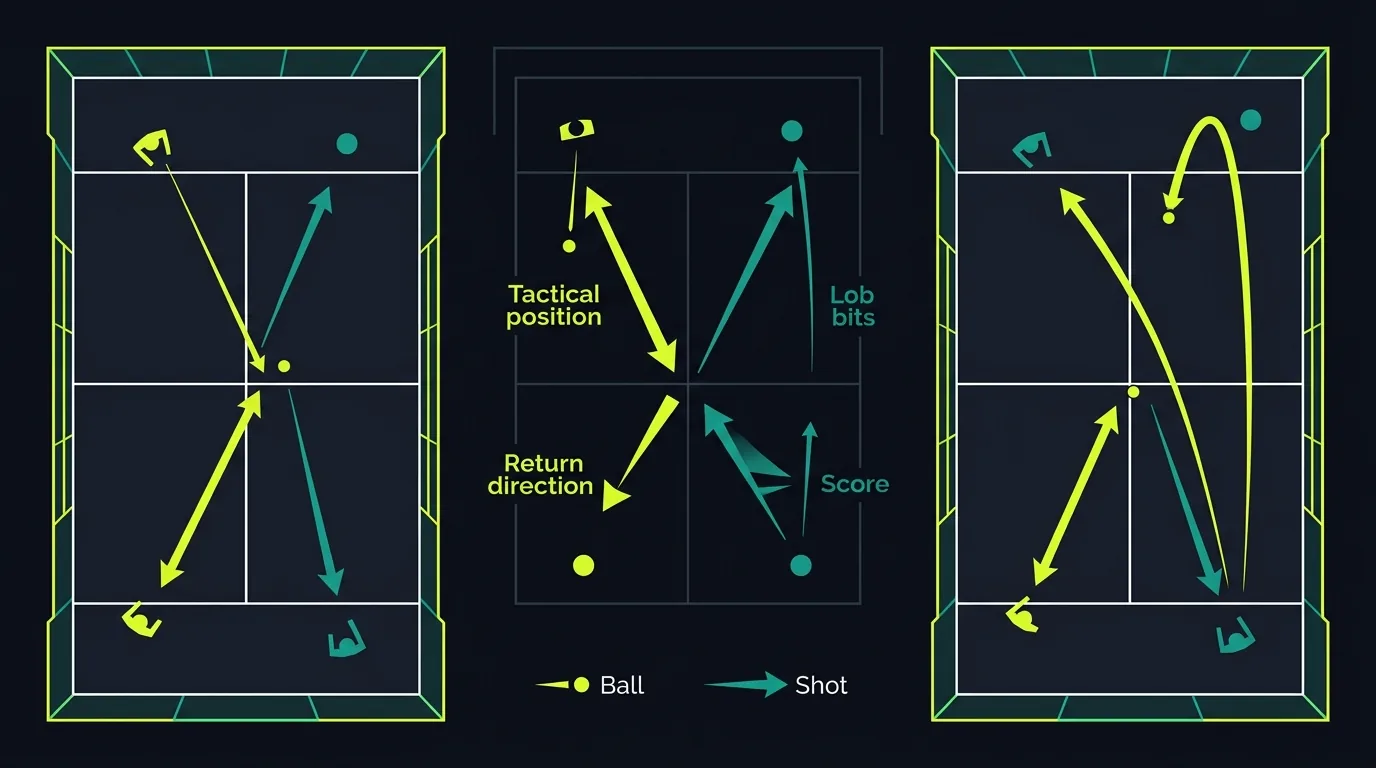
Your return trajectory — whether you hit it flat and low (a straight return) or high and deep (a lob) — should not be a habit. It should be a decision, driven by four specific cues: who you're targeting, what the score is, where the serving pair is positioned, and where the serve actually lands. Research from the 2021 World Padel Tour season mapped these patterns across thousands of professional points, and what it reveals has direct consequences for how you practise and how you read opponents.
The clearest pattern is this: male professionals tend to hit straight, low returns across most situations, while female professionals tend to favour lobs. But the interesting part is not the gender split — it is when these patterns are strongest and why that logic transfers to your game. Male players hit flat to the server particularly often when the serve comes to the body or hits the side glass (the glass panels running along the sides of the court), and when they are facing an Australian formation — the setup where the net player crosses to the middle before you return, cutting off the crosscourt angle. In those situations, the straight ball is the disciplined read: the obvious window is blocked, so you keep it low and direct rather than handing the crossing player an easy volley.
Female players at the professional level lean heavily on the lob across a broader range of situations: when directing the ball to the server's partner (not the server), when the serve comes to the "T" — the central junction of the service box — or to the body, and notably when the point is a golden point. The golden point is the decisive single point played at 40-40 under the current WPT rules, where the returning pair gets to choose which side they receive from. Under that pressure, the studied players shifted meaningfully toward height and depth. That is not coincidence. When the point is maximum weight, adding margin by going high and deep is a rational, repeatable response.
What also matters here is the Australian formation finding. When the serving pair deploys it, professionals go straight to the server rather than attempting to thread a crosscourt ball past the crossing player. That is a disciplined, pressure-resistant pattern you can train deliberately — recognise the formation early, decide before the ball arrives, and execute the lower-risk ball rather than the ambitious one.
Taken together, this research describes return choices as trained responses to context, not improvisation. The gaps between situations are large enough that they represent consistent decision-making, not noise. That means you can do the same: match your trajectory choice to the specific cue in front of you — serve direction, opponent position, score — rather than defaulting to whatever feels natural.
One honest caveat: these patterns describe what professionals choose in each situation. They do not prove that each trajectory wins that situation more often than the alternative. Use these findings as an informed baseline, not a rigid formula.
On court: try this
Recognise the Australian and go straight
Your opponents line up in an Australian formation — the net player is already stepping across the centre to take away your crosscourt return. The serve comes in hard to your body, jamming your swing. Instead of chasing the blocked crosscourt angle, punch the ball flat and low back along the line, into the server's feet. This is not a winner; it is a smart reset. You deny the crossing player an easy volley, force the server into a difficult low ball, and buy your partner at the net the time to read and position. The key cue: stay low on contact and direct the face straight, not angled.
Lob over the server's partner at golden point
The score is at deuce — golden point, your pair receiving. Standard formation. The serve lands on the "T" and you're slightly jammed. Rather than forcing a flat return with a cramped swing, open your racket face and send a high, deep lob over the server's partner toward the back glass (the rear glass wall). A well-executed lob here forces both opponents backward, takes the net player out of the point, and resets to neutral. Your pair can then step forward and take the initiative. Under maximum pressure, height and depth consistently outperforms attempted aggression.
Coach's tip: Lob trajectory in a golden point is not passive — it is the aggressive play for your position. You are attacking their time and their space, not conceding the point.
Straight return when the serve kicks off the side glass
The serve clips the side glass and spits wide, dragging you out toward the side fence. The instinct is to lob and reset, but the studied pattern for this serve direction runs the other way — flat and straight to the server. The geometry explains it: when you are pulled wide, the angle to the net player is poor and a crosscourt lob drifts into their reach. A firm, controlled ball along the line drops at the server's feet and forces them to volley upward while you recover. Step sideways to the ball before swinging rather than reaching across your body.
Drills to practise
- Trajectory decision drill — With a partner serving, agree on three serve zones: body, side glass, and "T". Before each serve, your partner calls a score context ("normal" or "golden point") and sets their formation (standard or Australian). Your task: call your intended trajectory — "straight" or "lob" — out loud before you swing, then execute it. Rally is not the focus. Do 15 reps per zone. You are improving when your declared choice matches the situational cue automatically, without deliberating mid-swing.
- Pressure lob to the back glass — Set every feed as a golden point. Your partner serves only to the "T" or body. Your only permitted return is a lob directed over the non-serving side, high and deep enough to reach the back glass on the full. Measurement: if your partner can step forward and intercept before the glass, the ball was not deep enough. Ten reps per session; target eight or more reaching the glass.
- Australian response lines — Your partner serves and their net player walks into the Australian crossing position before you strike. Your target: a flat, low return along the line past the crossing player into the server's side. Place a cone one metre inside the service box directly ahead of you. Ten reps from each side. The crossing player is live feedback — if they can deflect the ball, you are going crosscourt or lifting it too high.
- Side-glass recovery return — Have a partner feed a wide serve that bounces off the side glass at full stretch. Focus: get sideways to the ball before contact, keep the swing compact, and send it flat and straight, below net height. Count how many in a set of ten land on the straight line, keeping the ball low. Aim for seven or more landing where you intend.
Common mistakes
- Lobbing every time you're pulled wide by a glass kick. The glass return pulls you off the court and a high ball feels safe — but it often floats toward the net player's reach. Fix: step into the ball early, use a compact, slightly open face, and keep it straight and low to the server.
- Forcing a crosscourt ball against an Australian formation. The Australian setup exists to take that exact ball away. Attempting it gives the crossing player a controlled, well-positioned volley. Fix: accept the straight return as your first option; only consider crosscourt if the net player is clearly late to cross and the gap is real.
- Treating every point identically regardless of score. Most club players only acknowledge the score once they are one point from losing the game. Fix: make deuce a deliberate trigger — when the score reaches 40-40, consciously raise your lob percentage on the return, especially if the serve is landing centrally or at your body.
- Half-committing on a lob from a "T" serve. The central serve jams your swing arc slightly; a flat return without enough clearance hits the net, but a half-hearted lob lands mid-court and invites an overhead. Fix: commit fully — if you are lobbing, get height and depth; if you are going flat, get low and direct. The hybrid shot between them is where most errors live.
Take it to your next match
Pick one trigger and own it: when the score reaches deuce, default to a lob return, especially if the serve comes to the "T" or your body. You do not need to rebuild your return game — just attach one deliberate decision to one specific moment. Use the golden-point rule to your advantage: your pair chooses which side to receive from, so set your position, commit to the lob over the server's partner, and trust the pattern. One rehearsed response under pressure will do more for you than ten instinctive guesses.